Briefing Room
ACCESS CODES ARE ISSUED TO QUALIFIED PARTNERS BY SAT.
ACCESS DENIED — INVALID CODE
This area contains no export-controlled technical data.
Request an access code: contact SAT.
Executive Team

Luke Wolkiewicz
Over a decade of propulsion and internal combustion engine development for unmanned aerial platforms. Founder of JabFly (Poland, 2014) and JabFly Research Corporation (Canada); led development of a novel UAV engine architecture recognized by the Government of Canada in 2019 and showcased at EAA AirVenture and the NASA Innovation Center. Leads SAT and Project AMPERE's U.S. operations.
PROFILE →
Bernhard Otterstein
Vancouver-educated economist (UBC Sauder School of Business — honours) with decades of experience in strategic investment planning, commercialization of emerging technologies, and trade across North America, Europe, the Middle East, and Asia. He fosters Canada–EU trade and investment under CETA. President of the Polish Canadian Chamber of Commerce and former Chairman of the International Group of Chambers of Commerce. Serves on various corporate boards. Fluent in English, German, and Polish.
PROFILE →
Marek Urbanski
Electro-mechanical designer specializing in precision mechanical engineering, CAD modeling, FEA validation, and prototype development. As Lead Design Engineer at AMPERe he worked directly on advanced internal combustion engine designs, long-range VTOL drone platforms, tooling, and test procedures, later designing power-generation and structural systems at Paramount Power Systems (Canada). He leads SAT's mechanical design, prototyping, and structural integration — from engine components to airframe interfaces.
PROFILE →
Artur Welman
Senior business executive specializing in strategic technology deployment, with decades of experience financing, developing, and implementing mission-critical technological solutions. Artur has delivered cross-sector innovations spanning resource management, engineering, and special projects. A specialist in navigating complex tasks and high-stakes environments, he excels at distilling critical priorities into measurable business outcomes — driving SAT's manufacturing operations toward disciplined, sustainable growth.
PROFILE →
John Pauk
With over 35 years of specialized expertise in two-stroke engine development and competition propulsion systems, John brings deep technical knowledge in high-performance combustion optimization, engine tuning, and precision manufacturing. His background spans competitive racing platforms and R&D programs focused on advanced internal combustion architectures. He leads SAT's transition from prototype development into qualified production, applying proven expertise in two-stroke efficiency, rapid iteration, and manufacturing scalability to build domestic production capacity.

Jeremiah Wolkiewicz
Holds DLA Export Control Compliance (ECC) certification and serves as SAT's designated Data Custodian, overseeing controlled-data handling and ITAR-governed engagements. A background in computer science, security, and networking supports SAT's compliance-first infrastructure and federal data-protection requirements.
PROFILE →Board of Advisors

Maj Gen Glenn Davis
Major General T. Glenn Davis brings more than three decades of United States Air Force logistics and sustainment leadership to Skywalk Aegis Technologies. Commissioned in 1984 as the top graduate of the University of South Carolina ROTC program, General Davis commanded five logistics and maintenance groups over his career and served as Deputy Director for Logistics Operations on the Joint Staff at the Pentagon. His assignments spanned combat deployments in support of Operations Northern Watch, Southern Watch, and Deny Flight, as well as senior logistics leadership roles at Air Force Materiel Command and Air Force Reserve Command. He holds a National Security Fellowship from the John F. Kennedy School of Government at Harvard University. General Davis has advised Skywalk Aegis Technologies since its earliest formation, working closely with the company for the past six years to support its defense engagement strategy and program development.

Jeffrey Fredenburgh
Jeffrey Fredenburgh is a research engineer who works closely with Vijay Narula, Founder and Chairman of Optimal Solutions and Technologies, Inc. (OST), on selected special projects and public-private partnership initiatives. OST supports federal, state, and commercial clients, including longstanding work associated with the Federal Emergency Management Agency and the National Flood Insurance Program. Through Mr. Narula, OST has also developed a historical public-private partnership with the Federal Aviation Administration, including research and program-development activity associated with Atlantic City International Airport and the William J. Hughes Technical Center. OST is the principal sponsor of the OST Sensors Platform and OST FireGuard initiatives. Mr. Fredenburgh supports Skywalk Aegis Technologies' business development and cross-sector partnership efforts.

Chris Korwin-Kuczynski
Chris Korwin-Kuczynski brings decades of public service and Polish-Canadian community leadership to Skywalk Aegis Technologies. He served as a Toronto City Councillor for twenty-two years, including a term as the city's deputy mayor, and worked as special assistant to Canada's federal Minister of State for Multiculturalism. A longstanding advocate for Polish-Canadian relations, he was instrumental in establishing the sister-city agreement between Toronto and Warsaw, led the effort to erect Toronto's monument to the victims of the Katyn massacre, and worked with the Canadian government to remove visa requirements for Polish citizens. He is an honorary Captain of the Canadian Navy and a recipient of the Knight's Cross of the Order of Polonia Restituta, one of Poland's highest civilian honors. Mr. Korwin-Kuczynski supports Skywalk Aegis Technologies' engagement across Polish government and business channels.

Lt Gen Scott Kindsvater
Lieutenant General Scott Kindsvater served as the 22nd Deputy Chairman of the NATO Military Committee, advising the NATO Secretary General and directing the daily operations of NATO's highest military authority. A command pilot with more than 3,600 flight hours, including over 600 combat hours in Iraq and Afghanistan, he is an F-15E Weapons School graduate and former Commandant of the U.S. Air Force Weapons School. His career included command of the 93rd Air Ground Operations Wing and the 82nd Training Wing, senior staff roles on the Joint Staff, and service as Deputy Chief of Staff for Operations and Intelligence at Supreme Headquarters Allied Powers Europe. General Kindsvater advises a number of defense-sector companies navigating government and allied engagement, and joined Skywalk Aegis Technologies' advisory network through his longstanding association with General Davis.
Four Core Patent Families
SAT's propulsion technology rests on four protected architecture families. Published records are summarized here; Polish counterpart filings are sealed under national-security provisions. Quantitative data is released under NDA.
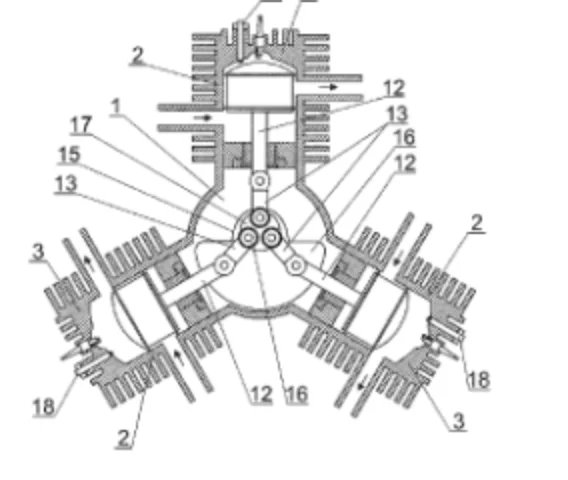
Two-Stroke Radial Configuration
A radial arrangement clusters multiple finned cylinders around a common crankcase, sharing a central crank assembly for high power density in a compact, air-cooled package. The layout scales the two-working-space combustion principle into a multi-cylinder powerplant suited to higher-thrust unmanned platforms.
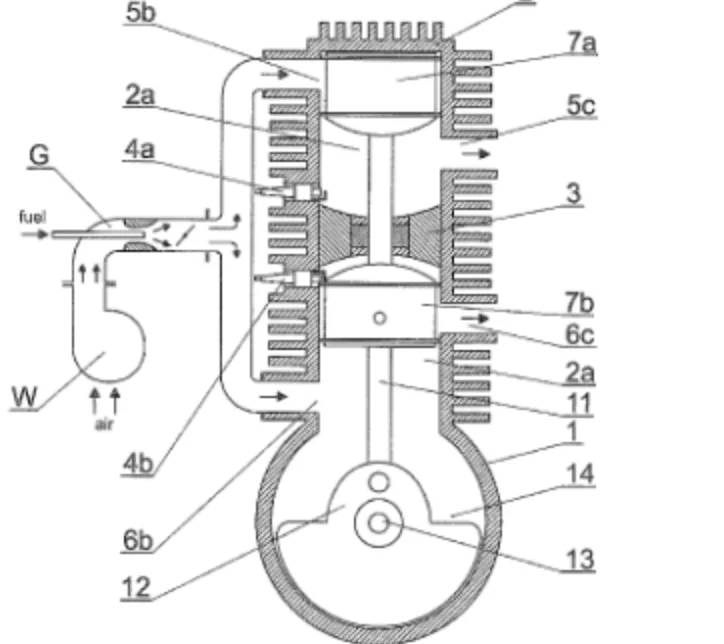
Two Working Spaces, One Cylinder
A bi-concave internal partition divides a single cylinder into upper and lower working spaces. A double piston runs between them; each side carries its own air inlet and exhaust orifices with sparking plugs, and the connecting rod ties the bottom piston through a linear bearing seal to the crankshaft — doubling firing events per cylinder.
Linear-Bearing Sealing System
A self-lubricating linear-bearing seal carries the connecting rod through the cylinder partition, removing the total-loss oil injection that defines legacy two-stroke designs. This is the element that makes clean two-stroke combustion viable, and it carries across both the air-cooled and liquid-cooled platform variants.
Withheld From Publication
Polish counterpart filings covering defense-relevant configurations are sealed under national-security provisions and are not published. Scope and claim structure are discussed only with cleared parties under NDA following export-control eligibility screening.
Specification Summary
Project Hussar
A low-cost, attritable propulsion platform developed for allied loitering-munition and one-way effector programs.
Project Hussar is SAT's dedicated low-cost engine program for allied attritable and loitering-munition platforms. In Poland, SAT has identified a significant gap in the domestic drone supply chain: while a growing number of Polish manufacturers are producing airframes under the country's EU-funded defense modernization push, propulsion remains almost entirely unaddressed. SAT is positioning Project Hussar to fill that gap directly, aligned with Poland's EU-backed defense investment programs and its rapidly expanding domestic drone sector. In parallel, SAT is evaluating engagement with the U.S. Department of Defense's low-cost attritable drone initiatives as a second qualification pathway for the same engine platform.
Fielded systems in this class run on internal combustion propulsion — the publicly disclosed U.S. LUCAS / FLM-136 test article among them. Airframe capacity is scaling quickly on both sides of the Atlantic; qualified, produceable engines are the constraint. That is the position SAT is building into.
Technical specifications, unit economics, and program schedule are released under NDA following export-control eligibility screening.
Project FireWing
SAT's propulsion contribution to a multi-partner civil wildfire-resilience initiative.
SAT contributes its liquid-cooled and air-cooled engine platform, including its patented self-lubricating linear-bearing technology, to Project FireWing, a joint initiative led by OST FireGuard alongside MEX, FlyFocus, ASG, and Acacia Thorn. The program integrates long-range drone response, robotic field logistics, and deployable power into a non-weaponized wildfire detection and mitigation concept, currently advancing through early program definition with partner alignment underway across all contributing organizations.
Program planning across the consortium contemplates a fleet on the order of 120,000 airframes to cover continental wildfire detection and early mitigation at useful response times — every one of them requiring an engine and a power architecture. Wildfire seasons in North America and southern Europe have lengthened to the point that aerial response capacity, not detection, is the limiting factor. FireWing targets that gap with persistent, non-weaponized platforms rather than crewed sortie surges.
OST FireGuard holds the Project FireWing name and trademark; SAT's role is limited to propulsion and power architecture.
Full technical documentation is released to verified parties under NDA following export-control eligibility screening.